Ocular Biometry and Anthropometric Measurement in Senile Cataract Patients
Article Sidebar
Main Article Content
Abstract
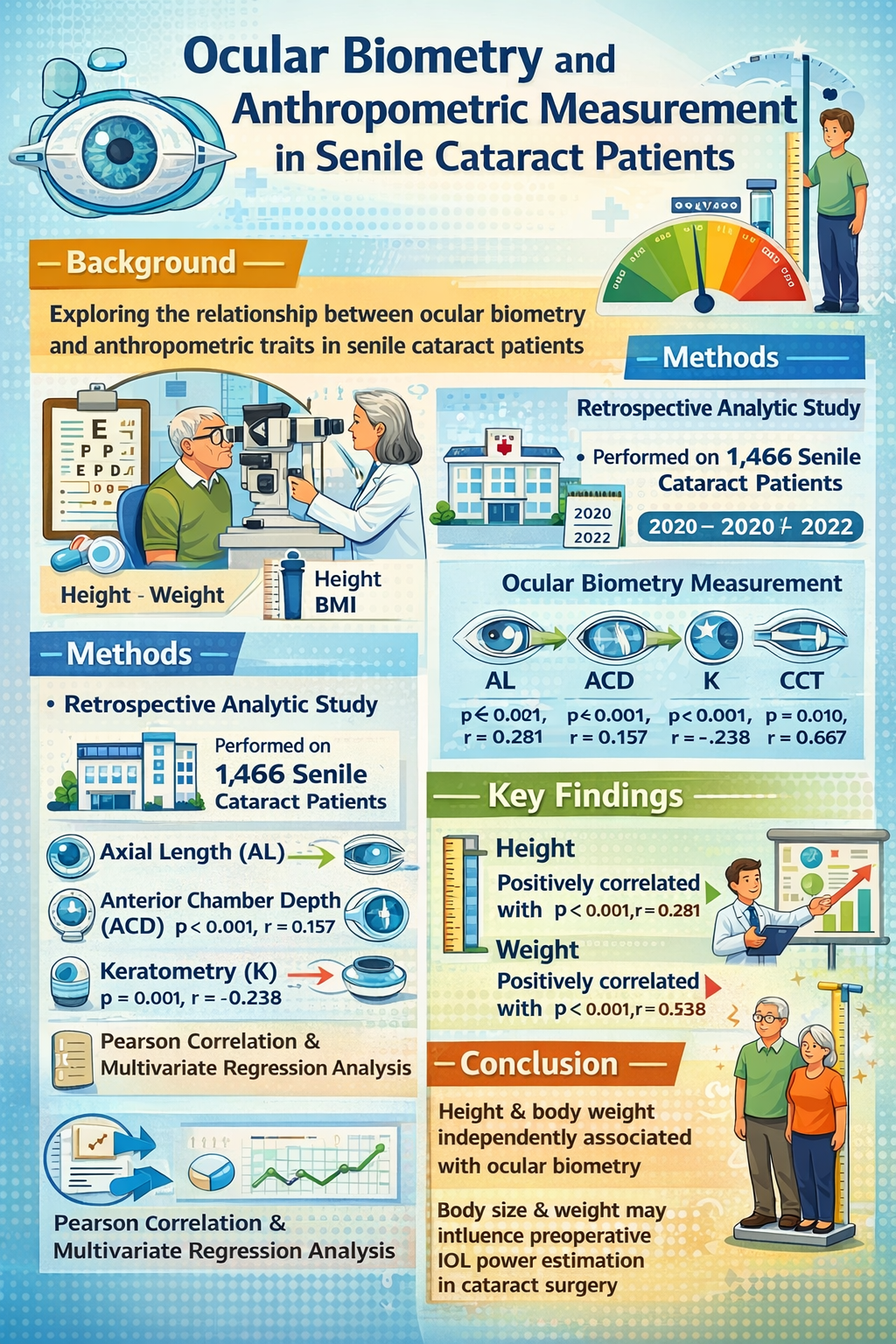
Background: Senile cataract is an age-related lens opacity and remains a leading cause of visual impairment. Accurate ocular biometry is essential before cataract surgery to determine appropriate intraocular lens (IOL) power. Ocular biometric factors may be influenced by anthropometric traits such as height, weight, and body mass index (BMI). This study aimed to explore the relationship between ocular biometry and these anthropometric characteristics in patients with senile cataracts
Methods: This retrospective analytic study used a cross-sectional design and included 1,466 senile cataract patients treated at a private hospital in Pekanbaru between June 2020 and January 2022. The anthropometric variables included height, body weight, and BMI, while ocular biometry measurements comprised axial length (AL), anterior chamber depth (ACD), keratometry (K), and central corneal thickness (CCT). Pearson correlation analysis was used to assess bivariate associations, and multivariate linear regression analysis was performed to determine independent relationships, controlling for age and gender. Due to collinearity between body weight and BMI, the latter was excluded from the final regression model.
Results: Height was positively correlated with AL (p < 0.001, r = 0.281) and ACD (p < 0.001, r = 0.157), and negatively with K (p < 0.001, r = −0.238). Body weight showed positive correlations with AL (p < 0.001, r = 0.210), ACD (p < 0.001, r = 0.149), and CCT (p = 0.010, r = 0.067), and a negative correlation with K (p < 0.001, r = −0.188). BMI demonstrated similar, albeit weaker, correlations. Age was negatively correlated with AL, ACD, and CCT. In multivariate analysis, height and body weight remained independently associated with AL and K, with body weight also independently linked to ACD.
Conclusion: Anthropometric parameters, particularly height and body weight, were independently associated with ocular biometric parameters in patients with senile cataracts. These findings suggest that body size and weight may influence ocular structural characteristics relevant to intraocular lens power calculation.
Article Details

This work is licensed under a Creative Commons Attribution 4.0 International License.
How to Cite
References
Astari P. Katarak: Klasifikasi, tatalaksana, dan komplikasi operasi. Cermin Dunia Kedokteran. 2018 Oct 1;45(10):748–53.
Manggala S, Jayanegara IWG, T2 AAMP. Gambaran karakteristik penderita katarak senilis di rumah sakit daerah mangusada badung periode 2018. E-Jurnal Medika Udayana. 2021 Jul 30;10(7):75.
Puspita R, Ashan H, Sjaaf F. Profil pasien katarak senilis pada usia 40 tahun keatas di RSI Siti Rahmah Tahun 2017. Health and Medical Journal. 2019 Jul 10;1(1):15–21.
Nur Aini A, Dyah Puspita Santik. Epidemiologi dan Biostatistika Y, Ilmu Kesehatan Masyarakat J. Kejadian katarak senilis di RSUD Tugurejo. HIGEIA (Journal of Public Health Research and Development). 2018 Apr 30;2(2):295–306.
Kemenkes RI. Infodatin Situasi gangguan penglihatan. Jakarta; 2018.
Departemen Kesehatan Republik Indonesia. Laporan hasil Riset Kesehatan Dasar (Riskesdas) Nasional 2013. Jakarta; 2013.
Harianja GM, Fatmawati NK, Sulistiawati S. Penurunan tekanan intraokular pasca operasi katarak dengan teknik fakoemulsifikasi di klinik mata SMEC Samarinda. Jurnal Kedokteran Mulawarman. 2020 Dec 29;7(3):6–13.
Novitasari M. Persiapan Operasi Katarak. Bandung; 2016.
Roy A, Kar M, Mandal D, Ray RS, Kar C. Variation of axial ocular dimensions with age, sex, height, BMI and their relation to refractive status. J Clin Diagn Res. 2015;9(1):AC01.
Badmus SA, Ajaiyeoba AI, Adegbehingbe BO, Onakpoya OH, Adeoye AO. Associations between ocular biometry and anthropometric measurements in a Nigerian population. Niger Postgrad Med J. 2016 Jul 1;23(3):127–31.
Gunes A, Uzun F, Karaca EE, Kalaycı M. Evaluation of anterior segment parameters in obesity. Korean Journal of Ophthalmology. 2015 Jul 21;29(4):220–5.
Gessesse GW, Debela AS, Anbesse DH. Ocular biometry and their correlations with ocular and anthropometric measurements among Ethiopian adults. Clinical Ophthalmology. 2020;14:3363–9.
Terasaki H, Yamashita T, Yoshihara N, Kii Y, Sakamoto T. Association of lifestyle and body structure to ocular axial length in Japanese elementary school children. BMC Ophthalmol. 2017 Jul 12;17(1):1–7.
Kolačko Š, Predović J, Kokot A, Bosnar D, Brzović-Šarić V, Šarić B, et al. Do gender, age, body mass and height influence eye biometrical properties in young adults? A pilot study. Int J Environ Res Public Health. 2021 Nov 8;18(21):11719.
Amra AA, Aldy F, Lubis B, Rahman E. The effect of anthropometry on refractive error and ocular biometry in children with β thalassemia major. Open Access Maced J Med Sci. 2021 May 14;9(T3):64–7.
Hadini A, Eso A, Wicaksono S. Analisis faktor risiko yang berhubungan dengan kejadian katarak senilis di RSU Bahteramas tahun 2016. J Medula. 2016;256–67.
Karunika AR, Resanindya V, Ardianti N, Wulandari KE. Gambaran faktor risiko penderita katarak di puskesmas kecamatan kebayoran baru. Nusantara Jurnal Ilmu Pengetahuan Sosial. 2020.
Nartey A. The pathophysiology of cataract and major interventions to retarding its progression: A mini review. 2017.
Ilyas S, Yulianti SR. Ilmu Penyakit Mata. Acneiform eruptions in dermatology: A differential diagnosis. 2014;129–53.
Chen H, Lin H, Lin Z, Chen J, Chen W. Distribution of axial length, anterior chamber depth, and corneal curvature in an aged population in South China. BMC Ophthalmol. 2016 May 1;16(1):1–7.
Wu HM, Gupta A, Newland HS, Selva D, Aung T, Casson RJ. Association between stature, ocular biometry and refraction in an adult population in rural Myanmar: The Meiktila eye study. Clin Exp Ophthalmol. 2007 Dec 1;35(9):834–9.
Wei S, Sun Y, Li S, Hu J, Cao K, An W, et al. Effect of body stature on refraction and ocular biometry in Chinese young adults: The Anyang University Students Eye Study. Clin Exp Optom. 2021 Feb 17;104(2):201–6.
Nangia V, Jonas JB, Matin A, Kulkarni M, Sinha A, Gupta R. Body height and ocular dimensions in the adult population in rural central India: The Central India Eye and Medical Study. Graefe’s Arch Clin Exp Ophthalmol. 2010 Nov 22;248(11):1657–66.
Panon N, Luangsawang K, Rugaber C, Tongchit T, Thongsepee N, Cheaha D, et al. Correlation between body mass index and ocular parameters. Clin Ophthalmol. 2019;13:755–62