Oral Maxillofacial Pathology Specialist and AI Supported for Histopathological Diagnosis of Oral Lesions
Article Sidebar
Main Article Content
Abstract
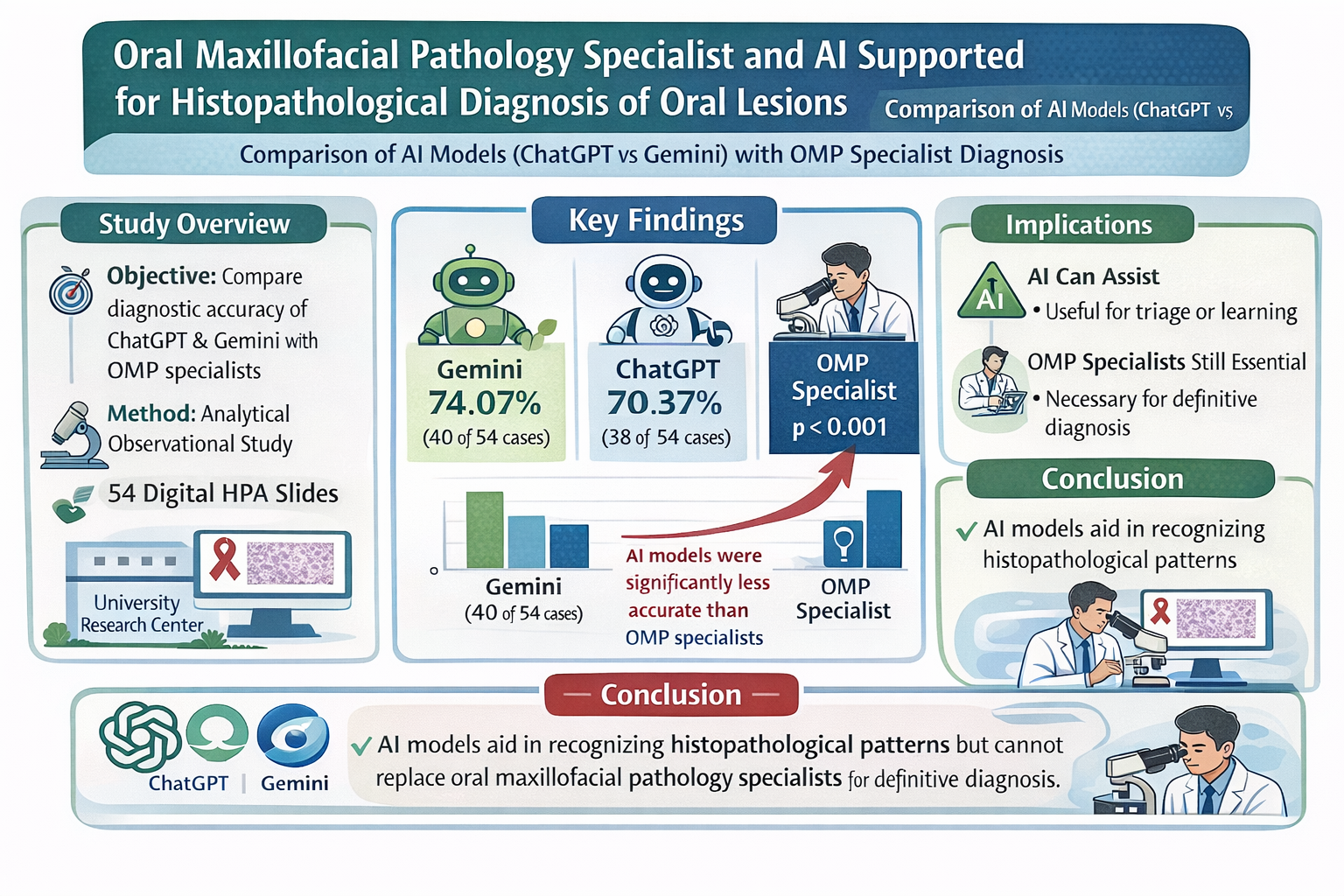
Background: Histopathological (HPA) analysis is the gold standard for oral lesions. However, clinical diagnoses often have low agreement rates (44.1%). Artificial intelligence (AI) may offer diagnostic assistance, but its accuracy requires critical evaluation. Purpose: This study compared the diagnostic accuracy of AI models, ChatGPT and Gemini, in interpreting HPA images of oral maxillofacial lesions to the gold standard diagnosis from Oral and Maxillofacial Pathology (OMP) specialists.
Methods: This analytical observational study used 54 digital HPA slides from a university research center. The diagnoses generated by ChatGPT and Gemini were evaluated for agreement ('Correct' or 'Incorrect') with the definitive diagnoses made by OMP specialists. Ethical approval was obtained.
Results: Gemini demonstrated a diagnostic accuracy of 74.07% (40 of 54 cases), while ChatGPT achieved 70.37% (38 of 54 cases). The most common lesions were mucoceles and dentigerous cysts. A statistically significant difference (<0.001) was observed between the accuracy of both AI models and the OMP specialist.
Conclusion: AI models showed considerable ability to recognize histopathological patterns, but their accuracy was significantly lower than OMP specialists. AI is an augmentative tool for triage or learning but cannot replace the role of OMP specialists in establishing a definitive diagnosis.
Article Details

This work is licensed under a Creative Commons Attribution 4.0 International License.
How to Cite
References
Alsanie IS, Qannam A, Bello IO, Khurram SA. Exploring the role of artificial intelligence in oral pathology: diagnostic and prognostic implications. J Oral Pathol Med. 2025 Aug;54(7):487-497.
Sindi AM, Aljohani K. Agreement between clinical and histopathological diagnoses of oral and maxillofacial lesions and influencing factors: a five-year retrospective study. Clin Cosmet Investig Dent. 2024 Aug 28;16:273-282.
Ernawati DS. Ilmu penyakit mulut (oral medicine) sebagai jembatan yang memfasilitasi ilmu. Pidato pengukuhan guru besar. Surabaya: Universitas Airlangga; 2011.
Tolstaya E, Tichy A, Paris S, Schw J, Aarabi G, Chaurasia A, et al. Machine learning versus clinicians for detection and classification of oral mucosal lesions. J Dent. 2025;161:105992.
Patil S, Albogami S, Hosmani J, Mujoo S, Kamil MA, Mansour MA, et al. Artificial intelligence in the diagnosis of oral diseases: applications and pitfalls. Diagnostics (Basel). 2022;12(5):1029
Xu Z, Lin A. Current AI Applications and Challenges in Oral Pathology. 2025; 5(1):2.
Guler R, Yalcin E. Performance of AI chatbots in preliminary diagnosis of maxillofacial pathologies. Med Sci Monit. 2025;31:e949076.
Hegde S, Ajila V, Zhu W, Zeng C. Artificial intelligence in early diagnosis and prevention of oral cancer. Asia Pac J Oncol Nurs. 2022;9(12):100133.
Vinay V, Jodalli P, Chavan MS, Buddhikot CS, Testarelli L. Artificial intelligence in oral cancer: a comprehensive scoping review of diagnostic and prognostic applications. Diagnostics (Basel). 2025;15(3):280
El-khoury R. The Rise of AI-Assisted Diagnosis : Will Pathologists Be Partners or Bystanders ? 2025;(1285):1–16.
Abdul NS, Shivakumar GC, Sangappa SB, Blasio M Di, Crimi S, Cicciù M, et al. Applications of artificial intelligence in the field of oral and maxillofacial pathology : a systematic review and meta analysis. BMC Oral Health. 2024;24;(1):1–12.
Li X, Zhao D, Xie J, Wen H, Liu C, Li Y, et al. Deep learning for classifying the stages of periodontitis on dental images : a systematic review and meta-analysis. 2023;1–23.
Lee L yu, Yang C han, Lin Y chieh, Hsieh Y han, Chen Y an, Chang MD tsyr, et al. A domain knowledge enhanced yield based deep learning classi fi er identi fi es perineural invasion in oral cavity squamous cell carcinoma. 2022;12(11):1–15.
Khoury ZH, Ferguson A, Price JB, Sultan AS, Wang R. Responsible artificial intelligence for addressing equity in oral healthcare. 2024;1(7):1–6.
Khanagar SB, Al-Ehaideb A, Patil S, Baeshen HA, Sarode SC. Developments, application, and performance of artificial intelligence in dentistry: a systematic review. J Dent Sci. 2021 Jan;16(1):508-522.
Sriram A, Ramachandran K, Krishnamoorthy S. Artificial Intelligence in Medical Education : Transforming Learning and Practice. 2025;17(3):1-10.
Sriram T, B GJ. From algorithm to applications : Artificial intelligence – A future prospective in medicine. 2025;4(2):44–52.
Bellahsen-harrar Y, Lubrano M, Lépine C. Exploring the risks of over-reliance on AI in diagnostic pathology . What lessons can be learned to support the training of young pathologists ? 2025;20(8):1–13.
Gharat MG, Deshpande SM, Dhone S, Shreesh V. Digital pathology: revolutionizing oral and maxillofacial diagnostics. 2024;20(12):1834-1840.
Chavarkar S. Artificial intelligence in pathology: bridging the gap between technology and diagnostics. 2026;14(1):251-264.
Abdollahi A. The role of artificial intelligence in the future of pathology. Iran J Pathol. 2026;21(1):160-162.
Khalaf A, Alkhalaf A, Alshammari MM. Integration of artificial intelligence in histopathological and radiological image analysis: enhancements in diagnostic workflow. 2024;8(S1):938-953.
Nieri M, Serni L, Clauser T, Paoletti C, Franchi L. Diagnosis of oral cancer with deep learning: a comparative test accuracy systematic review. Oral Dis. 2025 Aug;31(8):2368-2381.
McGenity C, Clarke EL, Jennings C, Matthews G, Freduah-Agyemang H, Stocken DD, et al. Artificial intelligence in digital pathology: a systematic review and meta-analysis of diagnostic test accuracy. 2024;7(1):114.