Development of a Group Counseling Model Using the CBT-AD Approach to Improve Coping Compliance with Taking Antiretriviral Drugs (ARV) in HIV/AIDS Patients
Article Sidebar
Main Article Content
Abstract
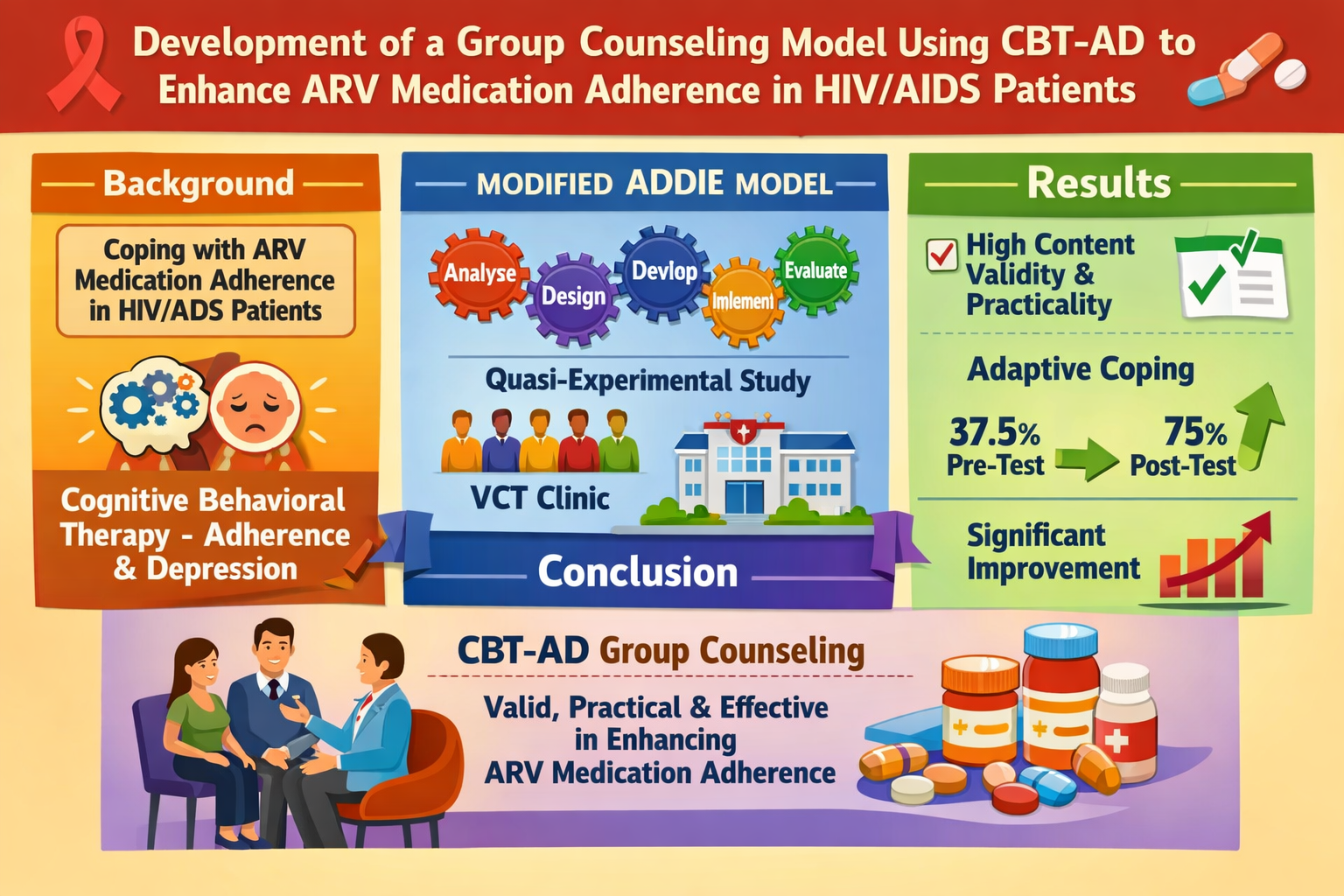
Background: Coping adherence to taking ARV medication is defined asstrategies and mechanisms that individuals use to deal with challenges associated with ARV treatment. This study aims to develop a group counseling model using the CBT-AD approach that is valid, practical, and effective in improving coping with ARV medication adherence.
Methods: This study is a developmental research employing a modified version of the ADDIE model (analyze, design, development, implementation, and evaluation). The product's validity is assessed by five experts, while its practicality is evaluated by five counselors. Additionally, the effectiveness of the product is measured through data gathered from eight test subjects. In this study, the data analysis for the needs analysis stage involved employing descriptive statistical analysis.
Results: Based on the research results, the CBT-AD group counseling model that was developed met the valid, practical, and effective criteria for improving coping with adherence to taking ARV medication in HIV/AIDS patients. The implementation of the CBT-AD group counseling model that was developed, there was a tendency for positive changes after being given CBT-AD group counseling. Statistical analysis and tracking of the end conditions of coping with ARV medication adherence proved that the application of the CBT-AD group counseling model was effective for increasing coping with ARV medication adherence in HIV/AIDS patients.
Conclusion: This finding is an alternative solution in order to improve coping with adherence to taking ARV drugs and be able to live a life in the future.
Article Details

This work is licensed under a Creative Commons Attribution 4.0 International License.
How to Cite
References
Alfitri A, Neviyarni N, Firman F, Syahlinda S, Ningsih R. Association of compliance and quality: the impact of antiretroviral administration during the COVID-19 pandemic in HIV/AIDS patients: a hospital-based study in Indonesia. J Curr Sci Res Rev. 2023;1(3):1-8.
Harding MM, Kwong J, Roberts D, Hagler D, Reinisch C. Lewis’s medical-surgical nursing: assessment and management of clinical problems. 10th ed. Philadelphia: Elsevier; 2020.
World Health Organization. Consolidated guidelines on HIV prevention, testing, treatment, service delivery and monitoring. Geneva: World Health Organization; 2021.
Panel on Antiretroviral Guidelines for Adults and Adolescents. Guidelines for the use of antiretroviral agents in adults and adolescents with HIV. Washington (DC): U.S. Department of Health and Human Services; 2022.
UNAIDS. Global HIV & AIDS statistics – fact sheet. Geneva: Joint United Nations Programme on HIV/AIDS; 2023.
Ministry of Health Republic of Indonesia. HIV/AIDS situation report in Indonesia. Jakarta: Ministry of Health Republic of Indonesia; 2022.
Kim MH, Mazenga AC, Yu X, Ahmed S, Devandra A, Nguyen C, et al. Impact of depression on antiretroviral therapy adherence among adults living with HIV. J Acquir Immune Defic Syndr. 2021;87(1):e1-e7.
Haberer JE, Sabin L, Amico KR, Orrell C, Galárraga O, Tsai AC, et al. Improving antiretroviral therapy adherence in resource-limited settings at scale. J Int AIDS Soc. 2021;24(2):e25634.
Lazarus RS, Folkman S. Stress, appraisal, and coping. New York: Springer Publishing Company; 1984.
Turan B, Budhwani H, Fazeli PL, Browning WR, Raper JL, Mugavero MJ, et al. How does stigma affect ART adherence? The role of depression and social support. AIDS Behav. 2022;26(2):521-532.
Kanyemba R, Govender K, Jimu C. Disclosure, coping, and medication adherence among young men living with HIV. Front Public Health. 2021;9:628725.
Ninnoni JP, Agyemang SO, Bennin L, Agyare E, Gyimah L, Senya K, et al. Coping with loneliness and stigma among people living with HIV. BMC Psychiatry. 2023;23:215.
Magidson JF, Joska JA, Remmert JE, O’Cleirigh C, Safren SA. Cognitive-behavioral interventions for antiretroviral therapy adherence in low-resource settings: a review. Curr HIV/AIDS Rep. 2022;19(1):23-31.
Keles S, Idsoe T. A meta-analysis of group cognitive behavioral therapy interventions for depression. J Adolesc. 2021;90:129-139.
Ridgway JP, Schmitt J, Friedman E, Taylor M, Devlin S, McNulty M, et al. HIV care continuum outcomes during the COVID-19 pandemic. AIDS Behav. 2021;25(10):2770-2772.
Spinelli MA, Hickey MD, Glidden DV, Nguyen JQ, Oskarsson M, Havlir DV. Viral suppression rates in a safety-net HIV clinic during the COVID-19 pandemic. AIDS. 2021;35(1):1913-1917.
Magidson JF, Joska JA, Remmert JE, O’Cleirigh C, Safren SA. Cognitive-behavioral therapy to improve antiretroviral therapy adherence and mental health among people living with HIV: a systematic review. Curr HIV/AIDS Rep. 2022;19(1):23-31.
Joska JA, Andersen LS, Smith-Alvarez R, Magidson JF, Lee JS, O’Cleirigh C, et al. Nurse-delivered cognitive behavioral therapy for adherence and depression among people living with HIV: protocol for a randomized controlled trial. JMIR Res Protoc. 2021;10(2):e14200.
Himelhoch S, Medoff DR, Oyeniyi G. Group psychotherapy to reduce depressive symptoms among HIV-infected individuals: updated systematic review. AIDS Patient Care STDS. 2021;35(10):415-423.
Alfitri A, Neviyarni N, Firman F. Coping with ARV treatment adherence: a hospital-based study in Indonesia. J ReAttach Ther Dev Divers. 2023;6(9s2):244-249.