Psychological Well-Being Among People Living with HIV/AIDS: A Systematic Review of Psychosocial and Contextual Determinants
Article Sidebar
Main Article Content
Abstract
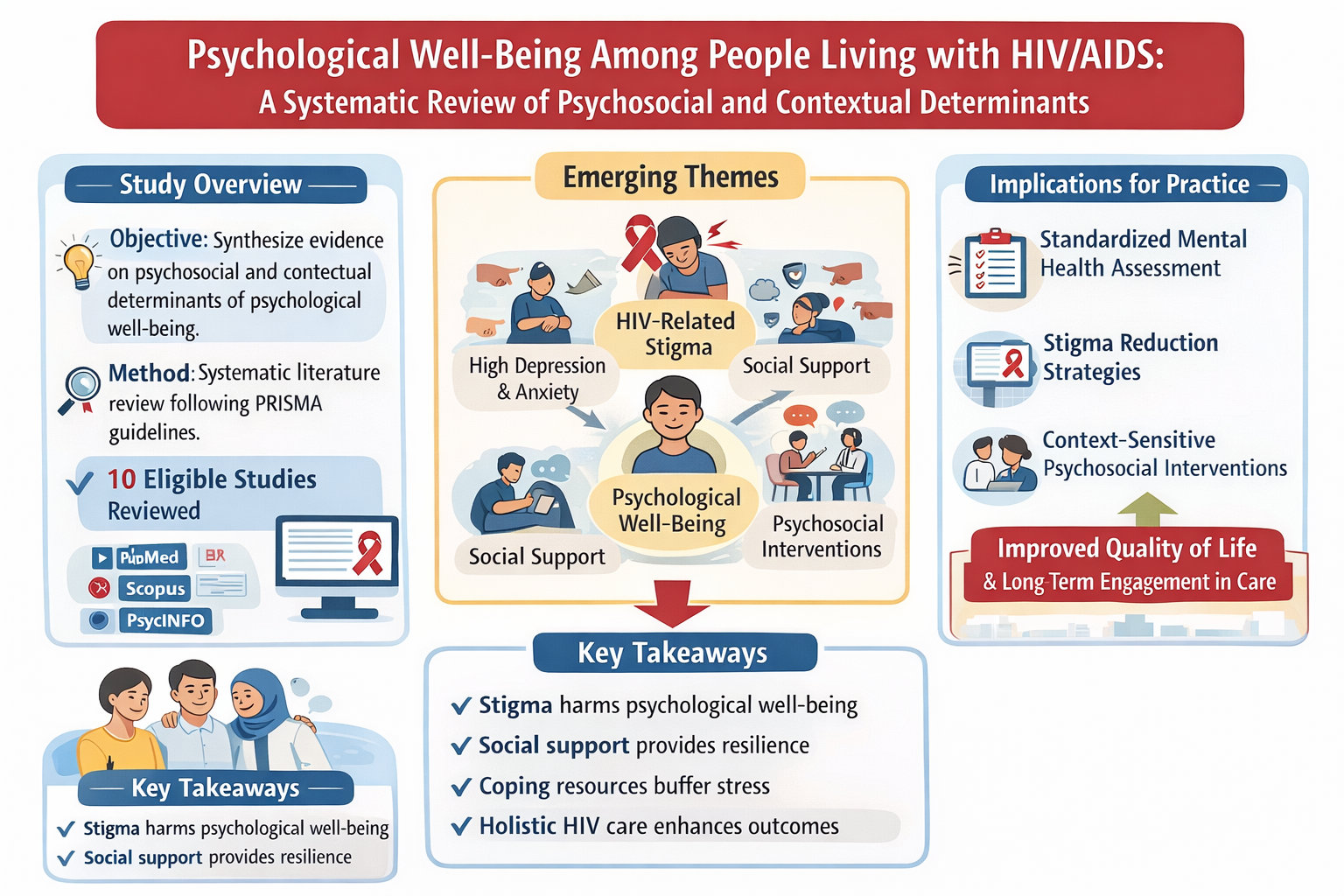
Background: Advances in antiretroviral therapy have transformed HIV into a chronic condition, yet psychological well-being remains inadequately addressed. Persistent stigma, psychological distress, and social inequities continue to compromise holistic health among people living with HIV/AIDS.
Objectives: This systematic review aimed to synthesize evidence on psychosocial and contextual determinants of psychological well-being among people living with HIV/AIDS and to identify implications for research and practice.
Methods: A systematic literature review was conducted following PRISMA guidelines. Peer-reviewed studies examining psychological well-being, mental health, stigma, coping, social support, and psychosocial interventions among adults living with HIV/AIDS were identified across major databases. Ten eligible studies, including observational studies, intervention trials, and systematic reviews, were critically appraised and synthesized using a thematic approach.
Results: Five interrelated themes emerged. HIV-related stigma consistently showed a negative association with psychological well-being across settings. High levels of depression and anxiety persisted despite antiretroviral treatment. Psychosocial resources, particularly social support, counseling, and adaptive coping, functioned as protective factors. Psychosocial interventions demonstrated beneficial but variable effects, with modest effect sizes and limited long-term evidence. Finally, psychological well-being was closely linked to behavioral outcomes, including treatment adherence and substance use, highlighting bidirectional relationships.
Conclusion: Psychological well-being among people living with HIV/AIDS is shaped by multilevel psychosocial and structural factors. Integrating standardized mental health assessment, stigma reduction strategies, and context-sensitive psychosocial interventions into routine HIV care is essential to improve holistic outcomes. Such integration may enhance quality of life, resilience, and long-term engagement in care worldwide across health systems and sociocultural contexts globally.
Article Details

This work is licensed under a Creative Commons Attribution 4.0 International License.
How to Cite
References
Alfitri, A, Neviyarni, N, Firman, F, Syahlinda, S, Ningsih,R Association of Compliance and Quality the Impact of Antiretroviral Administration During the COVID-19 Pandemic in HIV/AIDS Patients: A Hosptial Based Study in Indonesia. Journal of Current ScienceandResearch Review Volume 1 Issue 3 ISSN: 2961-0869https://jcsrr.org/index.php/jcsrr, 2023
Alfitri.A, Neviyarni,N Firman.F (2023). Coping with ARV Treatment Adherence to Medication Adherence A Hospital based Study in Indonesia. Journal for ReAttach Therapy and Developmental Diversities, 6(9s(2), 244–249. Retrieved from https://jrtdd.com/index.php/journal/article/view/1229
Alfitri,A, Yuniarti, E, Neviyarni,N, Firman,F Netrawati,N, Rihaliza,R, Azam M (2023) Pengaruh Konseling Kelompok Menggunakan Cognitive Behavioral Therapy Dalam Peningkatan Coping Adherene Pasien Hiv/Aids Menggunakan Obat Arv Di Poliklinik Voluntary Counseling Testing
Alfitri,A, Yuniarti, E, Neviyarni,N, Firman,F Netrawati,N, Rihaliza,R, Azam M (2025) Exhaustive Analysis of the Study of Antiretroviral Adherence Factor From HIV/AIDS Patients, Jurnal, https://doi.org/10.15294/ kemas.v20i3.21228
Amanyire J.M , Aheisibwe. I, Asiimwe .R and Rukundo G. Z 2025. Counselling and depressive symptoms in older adults with HIV/AIDS in mbarara, Uganda, BMC Psychology (2025) 13:840 https://doi.org/10.1186/s40359-025-03178-x
Drabarek, K. Rzeszutek, M. (2025). Profiles of HIV/AIDS stigma and psychological well-being in relation to embodiment among people living with HIV. Quality of Life Research (2025) 34:3257–3268 https://doi.org/10.1007/s11136-025-04085-9
Harding, M. M., Kwong, J., Roberts, D., Hagler, D., & Reinisch, C. (2020). Lewis’s Medical Surgical Nursing: Assessment and Management of Clinical Problems. 609. http://books.google.com/books?id=T-fN4bkfxysC&pgis=1
Hinkle, J. L., & Cheever, K. H. (2018). Brunner & Suddarth’s Textbook of Medical-Surgical Nursing. 14th edition. | Philadelphia : Wolters Kluwer, [2018] | Includes.
Lazarus, R. S., & Folkman, S. (1984). Stress, appraisal, and coping. Springer Publishing Company. https://doi.org/10.1891/0889-8391.13.2.163
Lemone, Burke, Levett-Jones, Dwyer, Moxham, Reid-Searl, Berry, Carville, Hales, Knox, 158 Luxford, & Raymond. (2017). Medical- surgical nursing:critical thinking for person centred care (Vol. 1). Pearson Australia 2017. www.pearson.com.au
Meyer, I. H. (2014). Minority stress and positive psychology: Convergences and divergences to understanding LGBT health. Psychology of Sexual Orientation and Gender Diversity, 1(4), 348–349. https://doi.org/10.1037/sgd0000070
Nasrah., Suweni, K., Maay, J.K.R., Arifin, S.R.M., Yousuf, A. 2023. Application of group positive psychotherapy to improve psychological well-being for people with HIV in Papua. Bali Medical Journal 12(1): 261-266. DOI: 10.15562/bmj. v12i1.3960
Obadeji.A, Oluwole L.O, Kumolalo.B, Ajiboye A.S (2021) Psychological well-being and gender differences in alcohol and substance use among people living with HIV/AIDS. HIV AIDS Rev 2021; 20, 2: 114-120 DOI: https://doi.org/10.5114/hivar.2021.107238
Poudel, A., Paudel, K., Adhikari, T. B., Adhikari, S., Chhetri, M., & Shrestha, R. (2025). Quality of life among people living with HIV/AIDS receiving antiretroviral therapy at Lumbini Provincial Hospital, Nepal. Discover Public Health, 22, 653. https://doi.org/10.1186/s12982-025-01046-y
Rzeszutek, M., Gruszczyńska, E., & Pięta, M. (2021). HIV/AIDS stigma and psychological well-being after 40 years of HIV/AIDS: A systematic review and meta-analysis. AIDS and Behavior, 25(7), 2150–2165. https://doi.org/10.1007/s10461-020-03132-4
Sun, W., Wu, M., Qu, P., Lu, C., & Wang, L. (2014). Psychological well-being of people living with HIV/AIDS under the new epidemic characteristics in China and the risk factors: A population-based study. International Journal of Infectious Diseases, 28, 147–152. https://doi.org/10.1016/j.ijid.2014.07.010
van der Heijden, I., Abrahams, N., & Sinclair, D. (2017). Psychosocial group interventions to improve psychological well-being in adults living with HIV. Cochrane Database of Systematic Reviews, 2017(3), CD010806. https://doi.org/10.1002/14651858.CD010806.pub2
World Health Organization. (2021). Guidelines on mental health at work. World Health Organization. https://www.who.int/publications/i/item/9789240031029
Higgins, P.T.J (2019), Cochrane Handbook for Systematic Reviews of Interventions, John Wiley & Sons.
Page et al. (2021): The PRISMA 2020 statement, updating guidelines for reporting systematic reviews, PLoS Med 2021 Mar 29;18(3):e1003583. doi: 10.1371/journal.pmed.1003583
Shea, B. J., B. C. Reeves, G. Wells, et al. 2017. “AMSTAR 2: A Critical Appraisal Tool for Systematic Reviews That Include Randomised or Non-Randomised Studies of Healthcare Interventions, or Both.” BMJ 358: j4008.