Effectiveness of Subcutaneous Bupivacaine–Ketamine Wound Infiltration in Reducing Post-Cesarean Section Pain: A Randomized, Double-Blind, Controlled Trial
Article Sidebar
Main Article Content
Abstract
Background: Effective postoperative analgesia supports maternal recovery after cesarean delivery, yet subcutaneous local anesthetic infiltration, a simple technique well suited to resource-limited settings, typically provides only 3–6 hours of relief. Ketamine, an NMDA-receptor antagonist with analgesic activity at subanesthetic doses, may extend this window, but evidence in cesarean delivery remains limited.
Objective: To determine whether adding subcutaneous ketamine to bupivacaine infiltration reduces rescue opioid requirement after cesarean delivery.
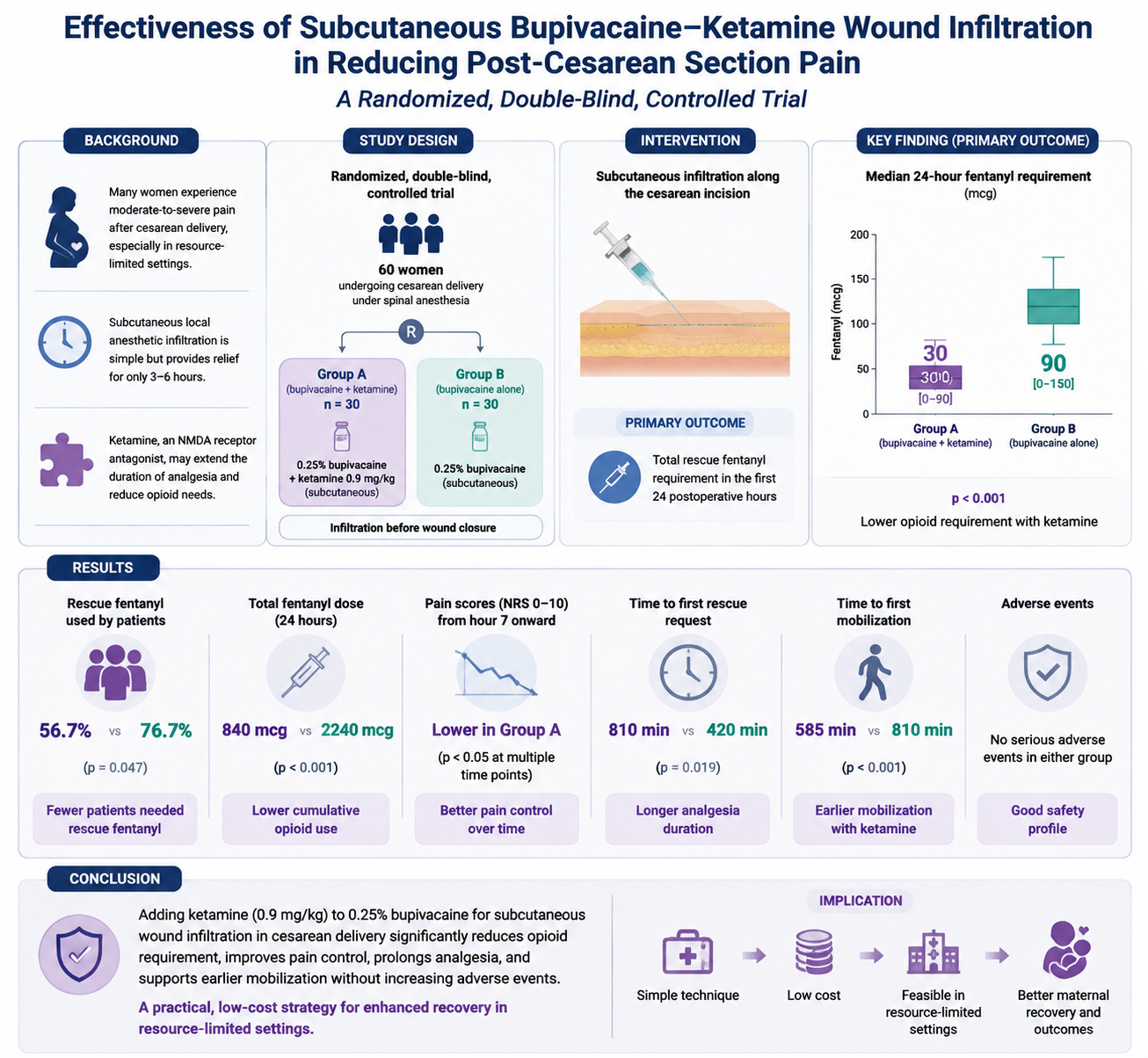
Methods: In this randomized, double-blind, controlled trial at Tangerang Regional General Hospital, Indonesia, 60 women undergoing cesarean delivery under spinal anesthesia were allocated 1:1 to subcutaneous infiltration of 0.25% bupivacaine with ketamine 0.9 mg/kg (Group A, n = 30) or 0.25% bupivacaine alone (Group B, n = 30) before wound closure. The primary outcome was total rescue fentanyl requirement in the first 24 postoperative hours.
Results: The median 24-hour fentanyl requirement was lower with ketamine (30 [0–90] vs 90 [0–150] mcg; p < 0.001), and fewer participants required rescue fentanyl at all (56.7% vs 76.7%), with a lower cumulative group dose (840 vs 2240 mcg). Group A also had lower pain scores from hour 7 onward, a longer interval to the first rescue request (810 vs 420 min; p = 0.019), and earlier first mobilization (585 vs 810 min; p < 0.001). No serious adverse events occurred in either group.
Conclusion: Adding subcutaneous ketamine to bupivacaine infiltration lowered the rescue opioid requirement and supported faster recovery after cesarean delivery, offering a practical, low-cost addition to multimodal analgesia in resource-limited settings.
Article Details

This work is licensed under a Creative Commons Attribution 4.0 International License.
How to Cite
References
Ronoatmodjo S. Factors that influence cesarean section deliveries in Indonesia. Jurnal Berkala Epidemiologi. 2020;8(3):238-45.
Kintu A, Abdulla S, Lubikire A, Nabukenya MT, Igaga E, Bulamba F, et al. Postoperative pain after cesarean section: assessment and management in a tertiary hospital in a low-income country. BMC Health Serv Res. 2019;19:1-6.
Sangkum L, Thamjamrassri T, Arnuntasupakul V, Chalacheewa T. The current consideration, approach, and management in postcesarean delivery pain control: a narrative review. Anesthesiol Res Pract. 2021;2021:1-20.
Roofthooft E, Joshi GP, Rawal N, Van de Velde M; PROSPECT Working Group. PROSPECT guideline for elective caesarean section: updated systematic review and procedure-specific postoperative pain management recommendations. Anaesthesia. 2021;76(5):665-80.
Stamenkovic DM, Bezmarevic M, Bojic S, Unic-Stojanovic D, Stojkovic D, Slavkovic DZ, et al. Updates on wound infiltration use for postoperative pain management: a narrative review. J Clin Med. 2021;10(20):4659.
Cheung CK, Adeola JO, Beutler SS, Urman RD. Postoperative pain management in enhanced recovery pathways. J Pain Res. 2022;15:123-35.
Abate SM, Mergia G, Basu B, Gezahegn M, Ayinie A. Efficacy and safety of ketamine wound infiltration for postoperative pain management: a systematic review and meta-analysis. Ann Med Surg (Lond). 2024;86:6046-61.
Behaeen K, Soltanzadeh M, Nesioonpour S, Ebadi A, Olapour A, Aslani SM. Analgesic effect of low dose subcutaneous ketamine administration before and after cesarean section. Iran Red Crescent Med J. 2014;16(3):e15506.
Aksoy H, Gökahmetoğlu G, Ak M, Aksoy Ü. Subcutaneous wound infiltration of ketamine is superior to bupivacaine in terms of pain perception and opioid consumption after cesarean section: a double-blinded randomized placebo-controlled clinical trial. Eur Rev Med Pharmacol Sci. 2023;27(18):8720-9.
Rizk RSI, Refky MA, Zanfaly HI, Ibraheam AM. Postoperative analgesic effect of using bupivacaine versus bupivacaine with dexmedetomidine or ketamine in cesarean section operations. Egypt J Hosp Med. 2022;88(1):3374-9.
Mishra P, Yadav J, Rai S, Singh RB. Comparative study among ketamine, fentanyl, and ropivacaine, as pre-incisional analgesic given by surgical site infiltration, in cases posted for elective lower segment cesarean section under general anesthesia. Cureus. 2021;13(2):e13609.
Zohar E, Luban I, Zunser I, Shapiro A, Jedeikin R, Fredman B. Patient-controlled bupivacaine wound instillation following cesarean section: the lack of efficacy of adjuvant ketamine. J Clin Anesth. 2002;14(7):505-11.
Sun J, Zhang X, Zhang X, Li Y, Wang Y. Ketamine suppresses NF-κB activation and pro-inflammatory cytokine expression in lipopolysaccharide-induced RAW264.7 macrophages. Immunopharmacol Immunotoxicol. 2004;26(2):247-57.
Bartoc C, Frumento RJ, Goldberg J, Fisher S, Guarino J, Marymont J, et al. The effect of ketamine on serum C-reactive protein and interleukin-6 in patients undergoing coronary artery bypass graft surgery. Anesth Analg. 2006;103(4):818-22.
Afify N, Mahdy W. Local wound infiltration with fentanyl vs ketamine after open abdominal hysterectomy: a prospective, randomized, double-blind study. Anaesth Pain Intensive Care. 2023;27(2):250-5.
Mohamed SA, Mostafa MF, Nassar AM. Effect of local wound infiltration with ketamine versus dexmedetomidine on postoperative pain and stress after abdominal hysterectomy: a randomized trial. Eur J Pain. 2018;22(5):951-60.
Raj P, Sinha N, Kharwar RK, Singh D, Kumar S, Priye S, et al. Effects of local wound infiltration post-mastectomy using bupivacaine alone, bupivacaine with ketamine, and bupivacaine with dexmedetomidine: a randomized double-blind study. Cureus. 2024;16(7):e65727.
Eftekhar N, Honarmand A, Nematollahy Z. Effect of local ketamine subcutaneous injection at the incision site in reducing the postoperative pain score after transabdominal hysterectomy: a randomized, double-blind, controlled clinical trial. Pain Med. 2023;24(5):1234-9.
Schug SA, Chandrasena C, Siddiqui M. A review of the role of acute pain services in postoperative pain management. Anaesth Intensive Care. 2017;45(1 Suppl):13-7.
Wang J, Xu Z, Feng Z, Ma R, Zhang X. Impact of ketamine on pain management in cesarean section: a systematic review and meta-analysis. Pain Physician. 2020;23:135-48.
Manouchehrian N, Behboodi S. The effect of subcutaneous ketamine infiltration on postoperative pain in elective cesarean section under spinal anesthesia. Avicenna J Clin Med. 2015;21(4):286-93.