A Little of Everything, Just In Time: Multimodal Opioid-Sparing Anesthesia for a Twin Pregnancy in Decompensated Heart Failure Caused by Severe Mitral Stenosis
Article Sidebar
Main Article Content
Abstract
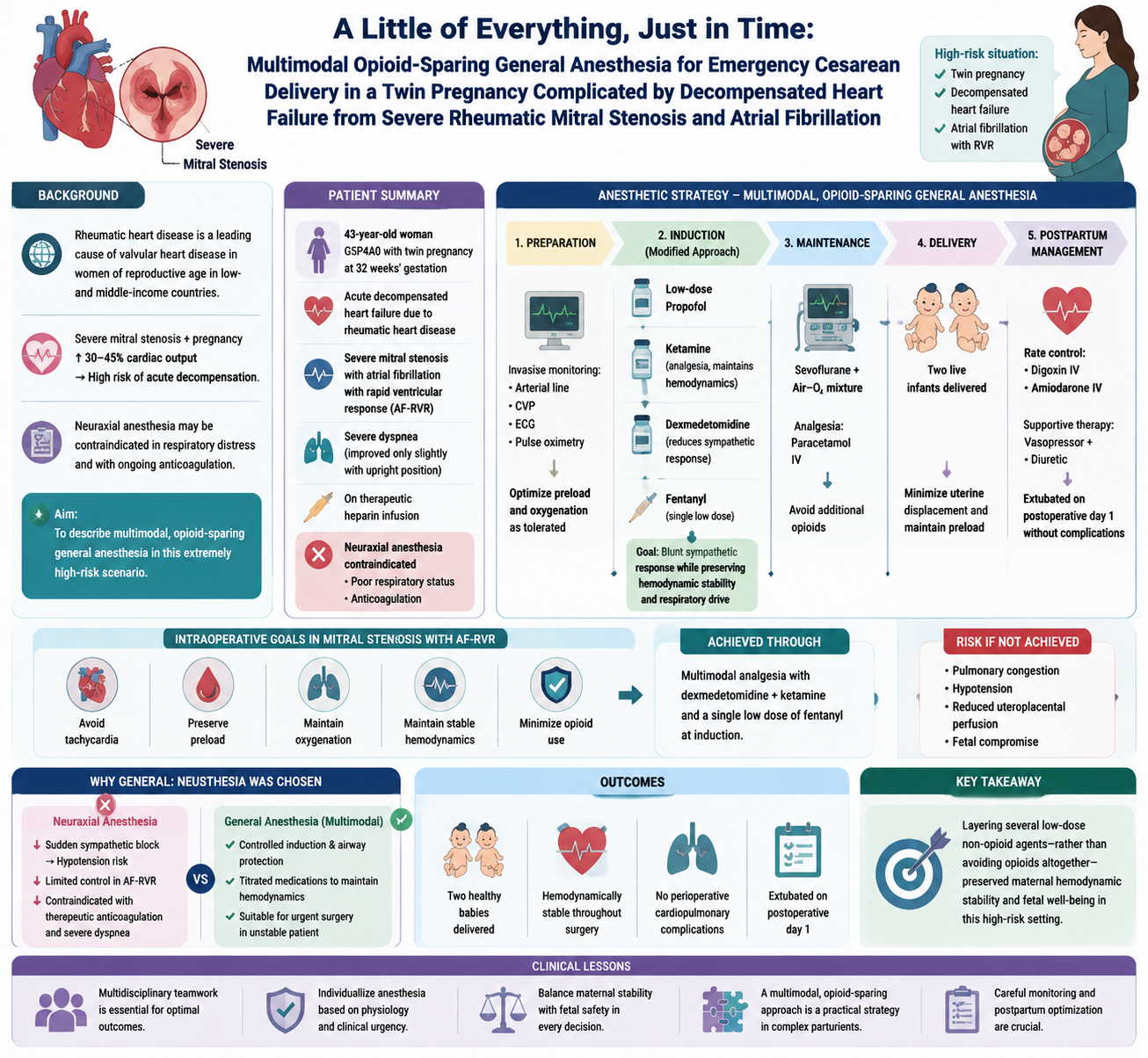
Background: Rheumatic heart disease remains a leading cause of valvular heart disease among women of reproductive age in low- and middle-income countries. Severe mitral stenosis complicating pregnancy substantially increases the risk of acute cardiac decompensation because of the hemodynamic load imposed by gestation, and anesthetic management becomes considerably more complex when it is combined with atrial fibrillation with a rapid ventricular response and a multifetal pregnancy. Reports describing general anesthesia for cesarean delivery in a twin pregnancy complicated by both severe mitral stenosis and atrial fibrillation remain scarce, which limits the guidance available to clinicians who face this specific combination.
Case Presentation: A 43-year-old woman, gravida 5 para 4 abortus 0, with a twin pregnancy at 32 weeks’ gestation was referred for emergency cesarean delivery because of acute decompensated heart failure secondary to rheumatic heart disease, with atrial fibrillation with a rapid ventricular response (AF-RVR) and severe mitral stenosis. Severe dyspnea that improved only marginally with upright positioning, together with an ongoing therapeutic heparin infusion, precluded neuraxial anesthesia. General anesthesia was therefore planned using a modified, opioid-sparing induction that combined low-dose propofol, ketamine, and dexmedetomidine under invasive hemodynamic monitoring. Two live infants were delivered; postpartum ventricular rate control was achieved with intravenous digoxin followed by amiodarone, alongside vasopressor and diuretic support. The patient was extubated on postoperative day 1 without further cardiopulmonary complications.
Discussion: The anesthetic strategy in mitral stenosis with AF-RVR must be directed toward avoiding tachycardia, preserving preload, and maintaining hemodynamic stability. These goals are difficult to reconcile with the sympathetic blockade produced by neuraxial techniques when these are otherwise contraindicated. A multimodal, opioid-sparing approach that layered dexmedetomidine and ketamine preserved maternal hemodynamics and respiratory drive while limiting opioid exposure before delivery to a single low dose of fentanyl given at induction; definitive antiarrhythmic therapy was deferred until after both infants had been born.
Conclusion: General anesthesia with a multimodal opioid-sparing strategy is a feasible and effective approach for high-risk parturients with stenotic valvular disease and arrhythmia when neuraxial techniques are contraindicated, provided that care is delivered through close multidisciplinary collaboration. The principal lesson is that sequencing several low-dose non-opioid agents, rather than avoiding opioids altogether, can preserve both maternal hemodynamic stability and fetal well-being in this setting.
Article Details

This work is licensed under a Creative Commons Attribution 4.0 International License.
How to Cite
References
Watkins DA, Johnson CO, Colquhoun SM, Karthikeyan G, Beaton A, Bukhman G, et al. Global, regional, and national burden of rheumatic heart disease, 1990-2015. N Engl J Med. 2017;377(8):713-22.
Butterworth JF, Mackey DC, Wasnick JD. Anesthesia for patients with cardiovascular disease. In: Morgan & Mikhail’s clinical anesthesiology. 7th ed. New York: McGraw-Hill Education; 2022. p. 408-10.
Passos LSA, Nunes MCP, Aikawa E. Rheumatic heart valve disease: pathophysiology and underlying mechanisms. Front Cardiovasc Med. 2021;7:612716.
Butterworth JF, Mackey DC, Wasnick JD. Maternal and fetal physiology and anesthesia. In: Morgan & Mikhail’s clinical anesthesiology. 7th ed. New York: McGraw-Hill Education; 2022. p. 824-8.
Luthra A, Bajaj R, Jafra A, Jangra K, Arya VK. Anesthesia in pregnancy with heart disease. Saudi J Anaesth. 2017;11(4):454-71.
Riley DS, Barber MS, Kienle GS, Aronson JK, von Schoen-Angerer T, Tugwell P, et al. CARE guidelines for case reports: explanation and elaboration document. J Clin Epidemiol. 2017;89:218-35.
American College of Obstetricians and Gynecologists’ Committee on Practice Bulletins-Obstetrics. ACOG Practice Bulletin No. 196: thromboembolism in pregnancy. Obstet Gynecol. 2018;132(1):e1-17.
Silversides CK, Grewal J, Mason J, Sermer M, Kiess M, Rychel V, et al. Pregnancy outcomes in women with heart disease: the CARPREG II study. J Am Coll Cardiol. 2018;71(21):2419-30.
Regitz-Zagrosek V, Roos-Hesselink JW, Bauersachs J, Blomström-Lundqvist C, Cífková R, De Bonis M, et al. 2018 ESC guidelines for the management of cardiovascular diseases during pregnancy. Eur Heart J. 2018;39(34):3165-241.
Thomas JS, Koh SH, Cooper GM. Haemodynamic effects of oxytocin given as i.v. bolus or infusion on women undergoing caesarean section. Br J Anaesth. 2007;98(1):116-9.
Kametas NA, McAuliffe F, Krampl E, Chambers J, Nicolaides KH. Maternal cardiac function in twin pregnancy. Obstet Gynecol. 2003;102(4):806-15.
Van Hagen IM, Thorne SA, Taha N, Youssef G, Elnagar A, Gabriel H, et al.; ROPAC Investigators and EORP Team. Pregnancy outcomes in women with rheumatic mitral valve disease: results from the Registry of Pregnancy and Cardiac Disease. Circulation. 2018;137(8):806-16.
Meng ML, Arendt KW, Banayan JM, Bradley EA, Vaught AJ, Hameed AB, et al. Anesthetic care of the pregnant patient with cardiovascular disease: a scientific statement from the American Heart Association. Circulation. 2023;147(11):e657-73.
Edwards P, Anyaogu C, Mezue K, Baugh D, Goha A, Egbuche O, et al. Focused cardiac ultrasound in pregnancy. J Investig Med. 2023;71(2):81-91.
Rudski LG, Lai WW, Afilalo J, Hua L, Handschumacher MD, Chandrasekaran K, et al. Guidelines for the echocardiographic assessment of the right heart in adults: a report from the American Society of Echocardiography. J Am Soc Echocardiogr. 2010;23(7):685-713.
Kopp SL, Vandermeulen E, McBane RD, Perlas A, Leffert L, Horlocker T. Regional anesthesia in the patient receiving antithrombotic or thrombolytic therapy: American Society of Regional Anesthesia and Pain Medicine evidence-based guidelines (fifth edition). Reg Anesth Pain Med. 2025.
Douglas MS, Soloniuk LJ, Jones J, Derderian R, Baker C, Stier G. Intravenous dexmedetomidine use in obstetric anesthesia: a focused review. Int J Obstet Anesth. 2025;62:104345.
Ao L, Shi J, Bai Y, Zheng Y, Gan J. Effectiveness and safety of intravenous application of dexmedetomidine for cesarean section under general anesthesia: a meta-analysis of randomized trials. Drug Des Devel Ther. 2019;13:965-74.
Nkuna AV. The pregnant cardiac patient and anaesthesia. South Afr J Anaesth Analg. 2022;28(5):5-9.
Mariani MV, Pierucci N, La Fazia VM, Cipollone P, Micillo M, D’Amato A, et al. Antiarrhythmic drug use in pregnancy: considerations and safety profiles. J Cardiovasc Dev Dis. 2024;11(8):243.
Kisat M, Fatimi SH, Sheikh L, Samad K. Mitral valve replacement in a twin pregnancy. J Obstet Gynaecol Res. 2011;37(7):916-8.
Beaton A, Okello E, Scheel A, DeWyer A, Ssembatya R, Baaka O, et al. Impact of heart disease on maternal, fetal and neonatal outcomes in a low-resource setting. Heart. 2019;105(10):755-60.