Effect of Preoperative Lactobacillus acidophilus Supplementation on Postoperative Gastric Residual Volume after Lower Digestive Laparotomy: A Randomized, Double-Blind, Controlled Trial
Article Sidebar
Main Article Content
Abstract
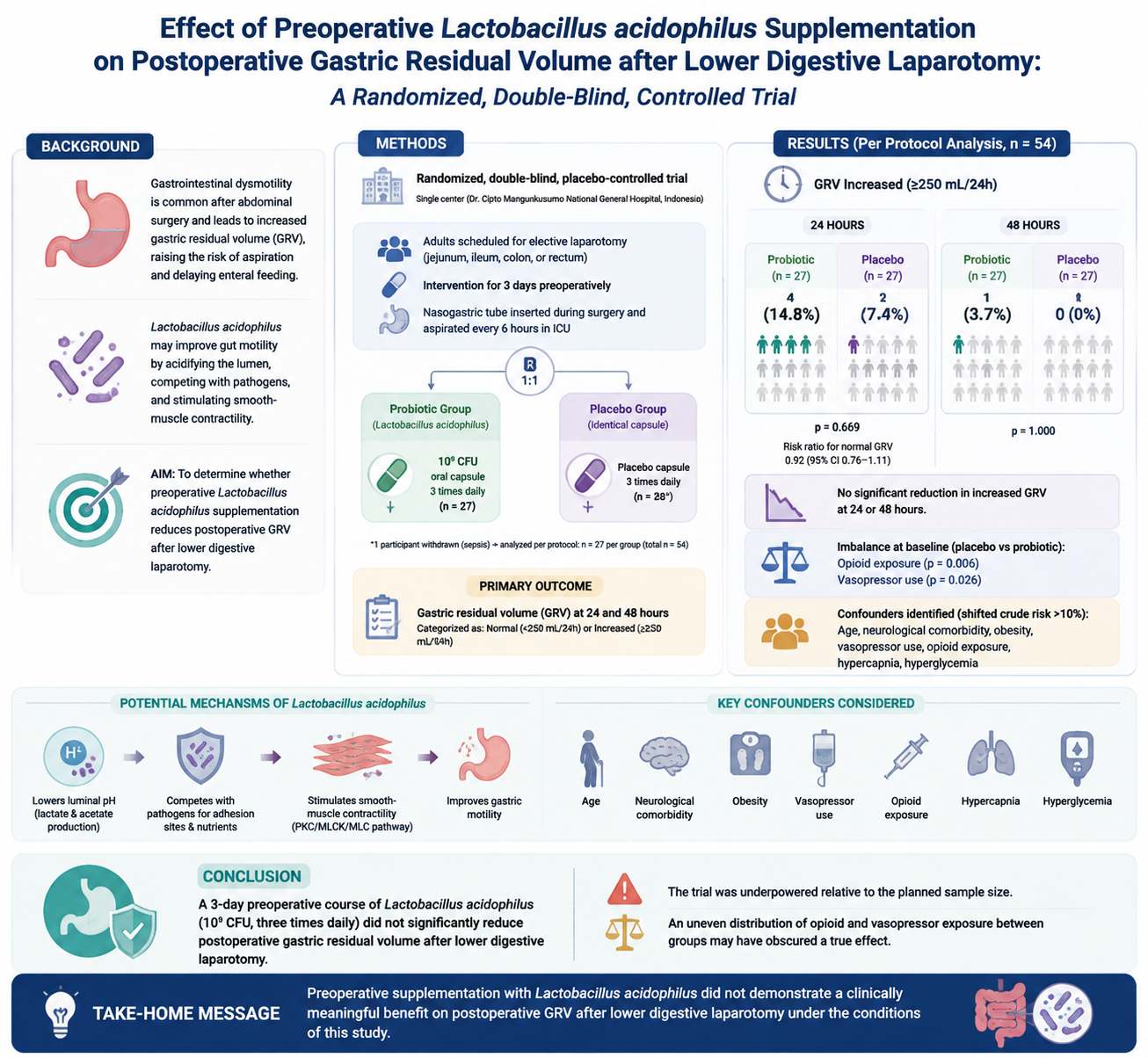
Background: Gastrointestinal dysmotility is among the most common complications after abdominal surgery and is reflected clinically by an elevated gastric residual volume (GRV), which increases the risk of aspiration and delays enteral feeding. Lactobacillus acidophilus is thought to improve gut motility through luminal acidification, competitive exclusion of pathogens, and direct stimulation of smooth-muscle contractility, but whether this translates into a lower GRV after digestive laparotomy has not been tested.
Objective: To determine whether preoperative Lactobacillus acidophilus supplementation reduces postoperative GRV after lower digestive laparotomy.
Methods: In this randomized, double-blind, placebo-controlled trial at Dr. Cipto Mangunkusumo National General Hospital, Indonesia, adults scheduled for elective laparotomy of the jejunum, ileum, colon, or rectum received oral Lactobacillus acidophilus 10⁹ CFU or an identical placebo capsule three times daily for three days before surgery. A nasogastric tube inserted during surgery was aspirated every 6 hours after ICU admission; GRV was categorized as normal (<250 mL/24h) or increased (≥250 mL/24h) at 24 and 48 hours.
Results: Fifty-five participants were randomized (27 probiotic, 28 placebo); one placebo-group participant was withdrawn because of sepsis, leaving 54 participants analyzed per protocol. GRV was increased in 4/27 (14.8%) probiotic recipients versus 2/27 (7.4%) placebo recipients at 24 hours (p = 0.669; risk ratio for normal GRV 0.92, 95% CI 0.76–1.11) and in 1/27 versus 0/27 at 48 hours (p = 1.000). Stratified analysis identified age, neurological comorbidity, obesity, vasopressor use, opioid exposure, hypercapnia, and hyperglycemia as confounders that shifted the crude risk estimate by more than 10%; opioid and vasopressor exposure were also unevenly distributed between groups at baseline (p = 0.006 and p = 0.026, respectively).
Conclusion: A 3-day preoperative course of Lactobacillus acidophilus did not significantly reduce postoperative GRV after lower digestive laparotomy. The trial was underpowered relative to its planned sample size, and an uneven distribution of opioid and vasopressor exposure between groups may have obscured a true effect.
Article Details

This work is licensed under a Creative Commons Attribution 4.0 International License.
How to Cite
References
Tengberg LT, Cihoric M, Foss NB, Bay-Nielsen M, Gögenur I, Henriksen R, et al. Complications after emergency laparotomy beyond the immediate postoperative period: a retrospective, observational cohort study of 1139 patients. Anaesthesia. 2017;72(3):309-16.
Ladopoulos T. Gastrointestinal dysmotility in critically ill patients. Ann Gastroenterol. 2018.
Aderinto-Adike AO, Quigley EMM. Gastrointestinal motility problems in critical care: a clinical perspective. J Dig Dis. 2014;15(7):335-44.
Zhang Z, Lv J, Pan L, Zhang Y. Roles and applications of probiotic Lactobacillus strains. Appl Microbiol Biotechnol. 2018;102(19):8135-43.
Sun B, Hu C, Fang H, Zhu L, Gao N, Zhu J. The effects of Lactobacillus acidophilus on the intestinal smooth muscle contraction through PKC/MLCK/MLC signaling pathway in TBI mouse model. PLoS One. 2015;10(6):e0128214.
Zhang JW, Du P, Yang BR, Gao J, Fang WJ, Ying CM. Preoperative probiotics decrease postoperative infectious complications of colorectal cancer. Am J Med Sci. 2012;343(3):199-205.
Indrio F, Neu J. The intestinal microbiome of infants and the use of probiotics. Curr Opin Pediatr. 2011;23(2):145-50.
Bajramagic S, Hodzic E, Mulabdic A, Holjan S, Smajlovic S, Rovcanin A. Usage of probiotics and its clinical significance at surgically treated patients suffering from colorectal carcinoma. Med Arch. 2019;73(5):316.
Amitay EL, Carr PR, Gies A, Laetsch DC, Brenner H. Probiotic/synbiotic treatment and postoperative complications in colorectal cancer patients: systematic review and meta-analysis of randomized controlled trials. Clin Transl Gastroenterol. 2020;11(12):e00268.
Reignier J. Effect of not monitoring residual gastric volume on risk of ventilator-associated pneumonia in adults receiving mechanical ventilation and early enteral feeding. JAMA. 2013;309(3):249.
Orel R. Effectiveness of Lactobacillus reuteri for prevention and treatment of functional gastrointestinal disorders in infants, children and adolescents. Zdrav Vestn. 2013;82(Suppl 1):I83-I93.
Mahmoodpoor A, Hamishehkar H, Asghari R, Abri R, Shadvar K, Sanaie S. Effect of a probiotic preparation on ventilator-associated pneumonia in critically ill patients admitted to the intensive care unit: a prospective double-blind randomized controlled trial. Nutr Clin Pract. 2019;34(1):156-62.
Justino PFC, Melo LFM, Nogueira AF, Morais CM, Mendes WO, Franco AX, et al. Regulatory role of Lactobacillus acidophilus on inflammation and gastric dysmotility in intestinal mucositis induced by 5-fluorouracil in mice. Cancer Chemother Pharmacol. 2015;75(3):559-67.
Ohland CL, MacNaughton WK. Probiotic bacteria and intestinal epithelial barrier function. Am J Physiol Gastrointest Liver Physiol. 2010;298(6):G807-G819.
Verdú EF, Bercik P, Collins SM. Effect of probiotics on gastrointestinal function: evidence from animal models. Therap Adv Gastroenterol. 2009;2(4 Suppl):S31-S35.
Soenen S, Rayner CK, Horowitz M, Jones KL. Gastric emptying in the elderly. Clin Geriatr Med. 2015;31(3):339-53.
Goyal RK, Guo Y, Mashimo H. Advances in the physiology of gastric emptying. Neurogastroenterol Motil. 2019;31(4):1-14.
Mejía-Rivas M, Remes-Troche JM, Montaño-Loza A, Herrera M, Valdovinos-Díaz MA. Gastric capacity is related to body mass index in obese patients: a study using the water load test. Rev Gastroenterol Mex. 2009;74(1):71-3.
Wells DL. Provision of enteral nutrition during vasopressor therapy for hemodynamic instability: an evidence-based review. Nutr Clin Pract. 2012;27(4):521-6.
Khansari M, Sohrabi M, Zamani F. The usage of opioids and their adverse effects in gastrointestinal practice: a review. Middle East J Dig Dis. 2013;5(1):5-16.
Madl C, Madl U. Gastrointestinal motility in critically ill patients. Gastroenterologe. 2019;14(1):43-53.
Plummer MP, Jones KL, Cousins CE, Trahair LG, Meier JJ, Chapman MJ, et al. Hyperglycemia potentiates the slowing of gastric emptying induced by exogenous GLP-1. Diabetes Care. 2015;38(6):1123-9.
Montejo JC, Miñambres E, Bordejé L, Mesejo A, Acosta J, Heras A, et al. Gastric residual volume during enteral nutrition in ICU patients: the REGANE study. Intensive Care Med. 2010;36(8):1386-93.