What Explains the Survival Gap? Decomposing Cross-National Inequality in Breast Cancer Mortality-to-Incidence Ratios Using Open Global Data Repositories
Article Sidebar
Main Article Content
Abstract
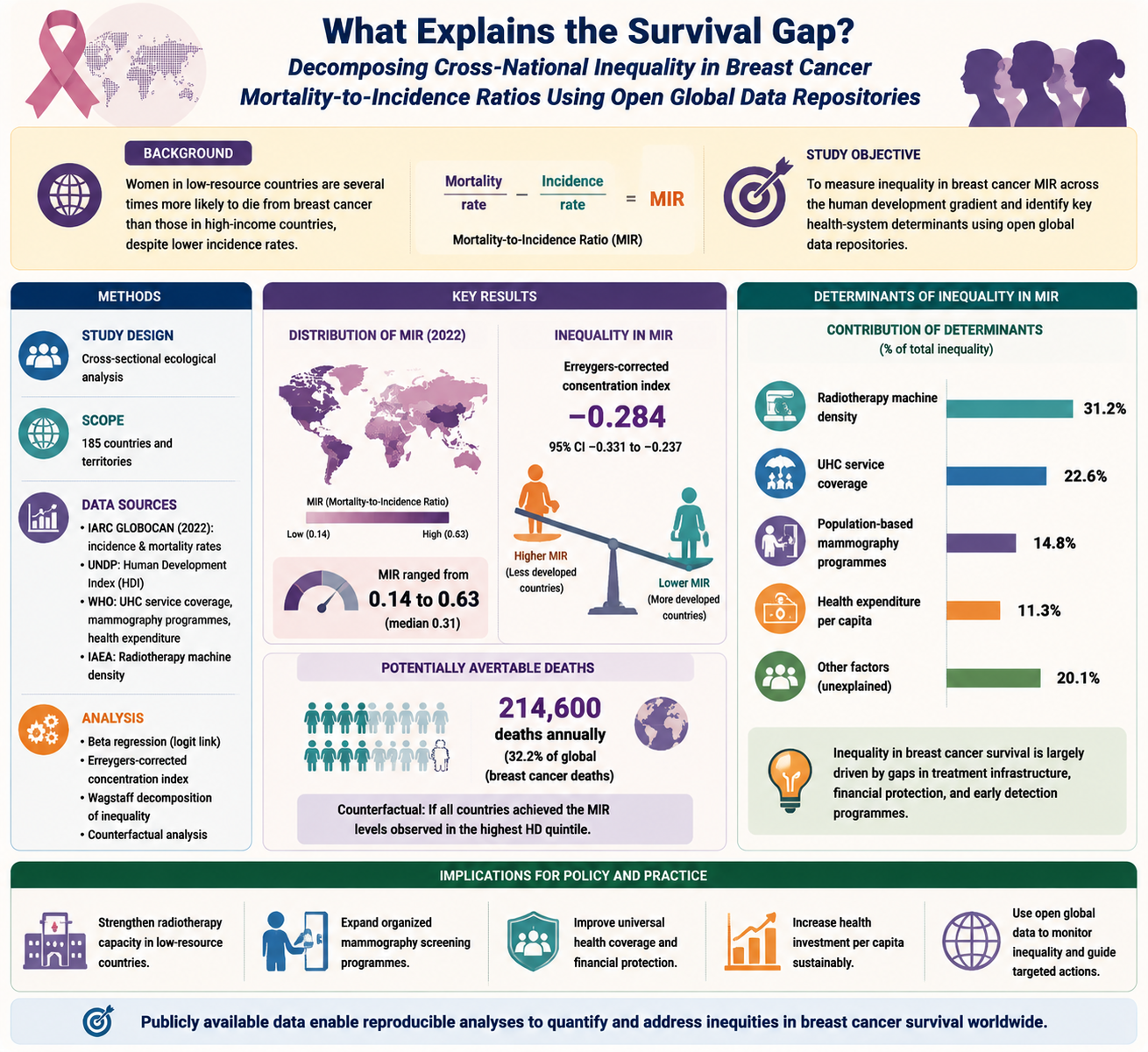
Background: Women diagnosed with breast cancer in low-resource countries are several times more likely to die from the disease than those in high-income countries, despite lower incidence. The mortality-to-incidence ratio (MIR) captures this survival gap, but previous studies have mainly described its association with national wealth rather than quantified the contribution of specific health-system factors. We aimed to measure inequality in breast cancer MIR across the human development gradient and identify key determinants using freely accessible and redistributable data sources.
Methods: We conducted a cross-sectional ecological analysis of 185 countries and territories. Breast cancer incidence and mortality rates for 2022 were obtained from the IARC Global Cancer Observatory. Explanatory variables were derived from UNDP, WHO, and IAEA databases. Associations were assessed using beta regression with a logit link. Inequality was measured using the Erreygers-corrected concentration index and decomposed by determinant contributions. A counterfactual analysis estimated potentially avertable deaths if all countries achieved MIR levels observed in the highest human development quintile.
Results: MIR ranged from 0.14 to 0.63 (median 0.31). The concentration index was −0.284 (95% CI −0.331 to −0.237), indicating higher MIR among less developed countries. Radiotherapy machine density contributed 31.2% of inequality, followed by UHC service coverage (22.6%), population-based mammography programmes (14.8%), and health expenditure per capita (11.3%). Approximately 214,600 deaths annually (32.2% of global breast cancer deaths) were potentially avertable.
Conclusion: Global inequality in breast cancer survival is strongly associated with measurable health-system capacity gaps, particularly treatment infrastructure. Publicly available data enable reproducible analyses to guide targeted improvements in cancer care equity
Article Details

This work is licensed under a Creative Commons Attribution 4.0 International License.
How to Cite
References
Bray F, Laversanne M, Sung H, Ferlay J, Siegel RL, Soerjomataram I, et al. Global cancer statistics 2022: GLOBOCAN estimates of incidence and mortality worldwide for 36 cancers in 185 countries. CA Cancer J Clin. 2024;74(3):229-63.
Asadzadeh Vostakolaei F, Karim-Kos HE, Janssen-Heijnen MLG, Visser O, Verbeek ALM, Kiemeney LALM. The validity of the mortality to incidence ratio as a proxy for site-specific cancer survival. Eur J Public Health. 2011;21(5):573-7.
Sunkara V, Hébert JR. The application of the mortality-to-incidence ratio for the evaluation of cancer care disparities globally. Cancer. 2016;122(3):487-8.
Wang H, Zhang S, Zhang J, Zhang X, Li X. Global patterns of breast cancer incidence, mortality, and mortality-to-incidence ratio in relation to socioeconomic development. Breast Cancer Res Treat. 2021;186(2):421-32.
Chen H, Xu L, Li L, Liu X, Gao J, Bai Y. Inequalities in breast cancer mortality-to-incidence ratios across world regions and their association with health system indicators. BMC Public Health. 2021;21(1):1930.
Sung H, Ferlay J, Siegel RL, Laversanne M, Soerjomataram I, Jemal A, et al. Global cancer statistics 2020: GLOBOCAN estimates of incidence and mortality worldwide for 36 cancers in 185 countries. CA Cancer J Clin. 2021;71(3):209-49.
Ferrari SLP, Cribari-Neto F. Beta regression for modelling rates and proportions. J Appl Stat. 2004;31(7):799-815.
O’Donnell O, van Doorslaer E, Wagstaff A, Lindelow M. Analyzing health equity using household survey data: a guide to techniques and their implementation. Washington, DC: World Bank; 2008.
Erreygers G. Correcting the concentration index. J Health Econ. 2009;28(2):504-15.
Wagstaff A, van Doorslaer E, Watanabe N. On decomposing the causes of health sector inequalities with an application to malnutrition inequalities in Vietnam. J Econom. 2003;112(1):207-23.
Anderson BO, Ilbawi AM, Fidarova E, Weiderpass E, Stevens L, Abdel-Wahab M, et al. The Global Breast Cancer Initiative: a strategic collaboration to strengthen health care for non-communicable diseases. Lancet Oncol. 2021;22(5):578-81.
Anderson BO, Shyyan R, Eniu A, Smith RA, Yip CH, Bese NS, et al. Breast cancer in limited-resource countries: an overview of the Breast Health Global Initiative 2005 guidelines. Breast J. 2006;12 Suppl 1:S3-15.
Nindrea RD, Armaita, Mardiah A, Ming LC, Syarief I, Putra MSKS, Falisha N, Cahyani RA, Mardhatillah TF, Elsaputri N. Assessing health beliefs and patient delay among breast cancer patients in West Sumatra, Indonesia. MethodsX. 2026;17:104035.
Nindrea RD, Novera M, Syahrial S, Avilla NA, Putri FAR. Scoring System for Predicting Breast Cancer Risk Among Women in Regions with Limited Healthcare Infrastructure in Indonesia. Asian Pac J Cancer Prev. 2026;27(4):1459-1467.
Foerster M, Anderson BO, McKenzie F, Galukande M, Anele A, Adisa C, et al. Inequities in breast cancer treatment in sub-Saharan Africa: findings from a prospective multi-country observational study. Breast Cancer Res. 2019;21(1):93.
Ginsburg O, Bray F, Coleman MP, Vanderpuye V, Eniu A, Kotha SR, et al. The global burden of women’s cancers: a grand challenge in global health. Lancet. 2017;389(10071):847-60.
Abdel-Wahab M, Zubizarreta E, Polo A, Meghzifene A. Improving quality and access to radiation therapy - an IAEA perspective. Semin Radiat Oncol. 2017;27(2):109-17.
Atun R, Jaffray DA, Barton MB, Bray F, Baumann M, Vikram B, et al. Expanding global access to radiotherapy. Lancet Oncol. 2015;16(10):1153-86.
Zubizarreta E, Van Dyk J, Lievens Y. Analysis of global radiotherapy needs and costs by geographic region and income level. Clin Oncol (R Coll Radiol). 2017;29(2):84-92.
World Health Organization. Global breast cancer initiative implementation framework: assessing, strengthening and scaling up services for the early detection and management of breast cancer. Geneva: WHO; 2023.
Hogan DR, Stevens GA, Hosseinpoor AR, Boerma T. Monitoring universal health coverage within the Sustainable Development Goals: development and baseline data for an index of essential health services. Lancet Glob Health. 2018;6(2):e152-68.
Nindrea RD, Aryandono T, Lazuardi L, Ingle RG, Ming LC, Alsaleh NA, Alsharif AA. Dietary fat and calorie consumption in relation to breast cancer risk in a multicenter Indonesian study. Clin Epidemiol Glob Health. 2026;39:102354.